Affichage des articles dont le libellé est Mickey. Afficher tous les articles

1 février 2016

Les ciseaux de Wiggin


Aucune trace de Wiggin, auteur de ces couvertures du Literary Digest, magazine new-yorkais fondé en 1890 par Isaac Kaufmann Funk, qui vit son audience s’effondrer en grande partie à cause de ses calamiteuses prédictions concernant l’élection présidentielle, comme celle prévoyant la victoire du gouverneur du Texas Alfred Landon en 1936, contrairement à Gallup nouvellement créé annonçant la nouvelle victoire de Roosevelt, ce qui imposa les sondages d’opinion fondés sur des échantillons représentatifs. Les couvertures de Wiggin en 1936 ne parvinrent pas à enrayer ce déclin qui s’acheva en 1938 quand il fut absorbé par The Review of Reviews.


n°494

12 janvier 2015

The Show Must Go On


Jack Welch, The Modern Screen Magazine, novembre 1930

Jack Welch, The Modern Screen Magazine, février 1931

Jack Welch, The Modern Screen Magazine, juin 1931

Jack Welch, The Modern Screen Magazine, septembre 1931

Jack Welch, The Modern Screen Magazine, août 1930

Jack Welch, The Modern Screen Magazine, décembre 1931

Jack Welch, The Modern Screen Magazine, janvier 1932

Jack Welch, The Modern Screen Magazine, février 1932

Jack Welch, The Modern Screen Magazine, avril 1932

Jack Welch, The Modern Screen Magazine, juin 1932

Jack Welch, The Modern Screen Magazine, juin 1932

Jack Welch, The Modern Screen Magazine, juillet 1932

Jack Welch, The Modern Screen Magazine, août 1932 

Jack Welch, The Modern Screen Magazine, octobre 1932

Jack Welch, The Modern Screen Magazine, novembre 1932

Jack Welch, The Modern Screen Magazine, avril 1933

Jack Welch, The Modern Screen Magazine, mai 1933

Jack Welch, The Modern Screen Magazine, juin 1933

Jack Welch, The Modern Screen Magazine, juillet 1933

Jack Welch, The Modern Screen Magazine, août 1933

Jack Welch, The Modern Screen Magazine, septembre 1933

Jack Welch, The Modern Screen Magazine, octobre 1933

Jack Welch, The Modern Screen Magazine, décembre 1933

Jack Welch, Silver Screen Magazine, janvier 1936


Je reproduis ci-dessous tout ce que j’ai trouvé sur Jack Welch  :


John William “Jack” Welch was born in Cleburne, Texas on April 16, 1905. His birth date is from the Social Security Death Index. In the 1910 U.S. Federal Census, Welch was the last of six children; preceding him were Grace (21), Madie (20), Ivy (18), Albert (13) and Gordon (7). Their parents were Frank, a retail grocer, and Beulah. The family lived in Cleburne at 109 Warren.

Welch lived with his parents and brothers Albert and Gordon in Temple, Texas at 109 North First Street, as recorded in the 1920 census. In high school, Welch contributed cartoons to the yearbook. According to Reed, Welch took the correspondence course of the W. L. Evans School of Cartooning. Bob said: “Jack wanted to go to art school after high school, but the local minister told his family that being an artist was not a suitable profession so his parents sent Jack to SMU [Southern Methodist University]. He lasted a year there, but his desire to be an artist led him to leave home and leave school and head to Chicago where he changed his name to Roy Sim(m)s and began a career as a political cartoonist. At some point, Jack had a comic strip as well.” Reed said Welch “…worked for papers in Texas, California, Seattle, Chicago, Philadelphia, and New York.”

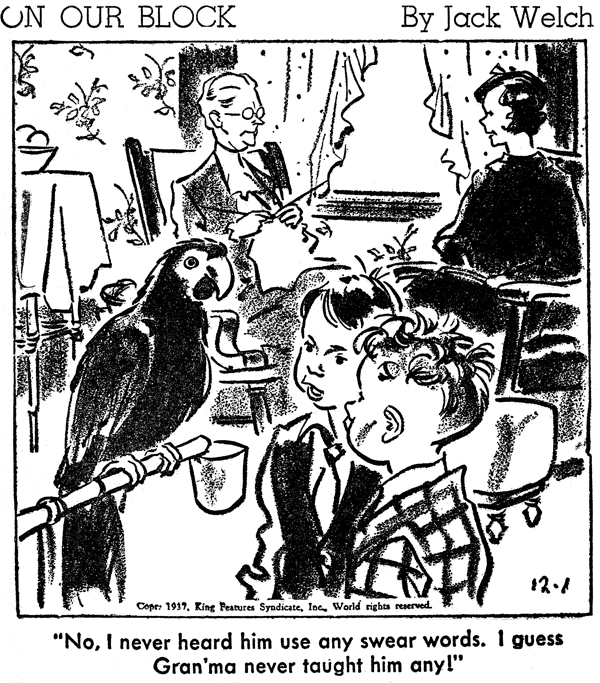
Welch has not yet been found in the 1930 census. According to American Newspaper Comics (2012), Welch’s What Price Vacation!, a series of color Sunday magazine covers, was published from June 29 to July 20, 1930. Around August 1937, his daily panel, On Our Block, was distributed by King Features, which ended it in early 1938. 


According to the 1940 census, Welch was married to Frances and lived in Leonia, New Jersey, at 31 Brook Terrace; in 1935, he resided in New York City. Welch was a freelance illustrator who worked 52 weeks and earned $5,000 the previous year. Some time later, Welch married Iowa native Ida Coquella Pilling, a teacher in Leonia. Bob said, “…Ida met Jack’s two major criteria for a mate, she was brilliant and she was as short as Jack was tall. Jack always felt that he was too tall and didn’t want his children to have that burden….”

Reed said Welch did sketches and comprehensive drawings for advertising layouts. He went on to produce finished art for advertisers such as Keds, Jell-O, Pullman, Traveler’s Insurance, and Birds Eye. His work came to the attention of the Saturday Evening Post for which he did several covers. 

A 1951 passenger list, at Ancestry.com, recorded Welch’s address as 80 Madison Avenue, Valhalla, New York.

According to the Social Security Death Index, Welch passed away in August 1985. His last residence was in Valhalla. An obituary has not been found.

—Alex Jay


http://strippersguide.blogspot.fr/2014_08_10_archive.html


n°433

22 décembre 2014

Mickey à Gurs


Dans ce livre récemment édité par Calmann-Lévy et le Mémorial de la Shoah, est publié l’intégralité des carnets dessinés par Horst Rosenthal en 1942 au camp de Gurs, dans le Béarn, avant d’être déporté et assassiné à Auschwitz.
Joël Kotek et Didier Pasamonik accompagnent ces carnets d’une riche étude historique qui tient aussi, écrivent-ils, de l’enquête policière, tant sont rares les pièces concernant Rosenthal qui fut de ceux à être interné par la France « en 1940 du fait de sa germanité, [avant qu’elle ne] le livre, deux ans plus tard, aux nazis, du fait de sa judéité ».
À Damigny-sur-Orne, où il fut “hébergé” en 1940, rencontra-t-il les dessinateurs Bil Spira, Antonín Pelc et Adolf Hofmeister qui nous ont déjà occupés ?

Un aperçu de ces carnets avait été publié il y a deux ans dans cette colonne.
https://www.blogger.com/blogger.g?blogID=4499126673120624220#editor/target=post;postID=3460912162805441016


http://www.campgurs.com


n°428

2 août 2014

Gloire et ingratitude


Paolo Garretto, Vanity Fair, 1934


Le Napolitain Paolo Garretto (1903-1989) émigra aux États-Unis où il se distingua en caricaturant tout ce que le monde comptait de personnalités, des arts et de la politique, pour Fortune, The New Yorker et surtout pour Vanity Fair dont il fut le porte-drapeau avec le Mexicain Miguel Covarrubias.
Mais cette gloire américaine ne lui fut d’aucun secours quand survint la Seconde Guerre mondiale puisqu’il fut expulsé vers l’Italie où il dut affronter de redoutables épreuves. http://www.nytimes.com/1989/08/08/obituaries/paolo-garretto-is-dead-italian-caricaturist-86.html


http://plusoumoinstrente.blogspot.fr/search/label/Paolo%20Garretto


n°394

6 juillet 2014

J.Carlos fait son cinéma


J.Carlos, Fon Fon

J.Carlos, Fon Fon

J.Carlos, Fon Fon

J.Carlos, Tico Tico, 1937

J.Carlos, Tico Tico, 1937

J.Carlos, Para Todos, 1924


J.Carlos, Para Todos, 1926

J.Carlos, Tico Tico, 1938

J.Carlos, Tico Tico, 1924


n°392

8 novembre 2013

Hollywood Party


Constantin Aladjalov, 1934 


Aladjalov donna un grand nombre de couvertures au New Yorker entre 1926 et 1960 (et quelques-unes au Chicagoan en 1928 et 1929). Né Russe en 1900, il émigra aux États-Unis à vingt-trois ans en plein Jazz Age.


1927

17 juillet 2013

Un trou dans l’histoire


Rubey, Jugend, 1935

Rubey est toujours aux abonnés absents, mis à part ses publications pendant quatre ans dans le Jugend, comme un trou (ein Loch) entre la page 63 et 64 du grand dictionnaire des dessinateurs. 


Rubey, Jugend, 1935


Rubey, Jugend, 1935


Rubey, Jugend, 1935


Rubey, Jugend, 1935


Rubey, Jugend, 1935


Rubey, Jugend, 1935


Rubey, Jugend, 1935


Rubey, Jugend, 1935


Rubey, Jugend, 1935


Rubey, Jugend, 1935